
Why Cornering Grip Is Everything
Let’s be honest—the real magic of motorcycling happens in the corners. Straight roads are easy; anyone can twist the throttle and go fast. But leaning into a curve, feeling the bike settle beneath you, and trusting it completely—that’s where the thrill truly lives. That moment is where rider confidence meets real-world physics.
At the core of that experience lies one critical factor: your motorcycle tyres. They determine whether a corner feels smooth and controlled or unpredictable and dangerous. With only two small contact patches connecting your bike to the road, every bit of lateral force, balance, and stability depends on how effectively those tyres manage grip under stress.
Cornering grip isn’t just about rubber touching the road—it’s about how that rubber behaves under dynamic load variation, how forces are distributed across the surface through contact patch pressure mapping, and how the tyre maintains stability within the limits of the traction circle. This invisible boundary defines how much braking, accelerating, and turning force your tyres can handle at any given moment, including braking force distribution during lean.
Understanding Cornering Grip – What Does It Really Mean?
Cornering grip refers to a tyre’s ability to maintain traction while the motorcycle is leaned over and subjected to lateral forces. It’s not a static property but a dynamic interaction between the tyre, the road surface, and the forces acting on the bike.
This grip depends on several key factors, including the coefficient of friction between rubber and road, the size and shape of the contact patch, and how pressure is distributed across it. Additionally, weight transfer during acceleration and cornering plays a crucial role, especially when combined with grip coefficient variation under stress.
Another important but often overlooked factor is that tyres operate within defined structural limits governed by tyre load index and speed rating compliance. These parameters ensure that the tyre can handle specific loads and speeds without compromising performance or safety. Once these limits are exceeded, grip begins to deteriorate rapidly, leading to the breakaway point where traction is lost.
The Science Behind Tyre Grip
As a motorcycle enters a corner, a complex series of physical interactions takes place. The rider initiates lean using countersteering, and the bike stabilizes due to gyroscopic forces generated by the wheels. At the same time, centrifugal force pushes the bike outward, while weight transfers across the tyres.
During this process, the contact patch shifts toward the shoulder of the tyre, and a small slip angle develops between the direction the wheel is pointing and the actual path it follows. This slip angle is essential because it allows the tyre to generate cornering force through deformation.
This deformation is heavily influenced by the tyre’s internal design, including tyre carcass flex characteristics, sidewall stiffness, and overall tyre carcass structure. A well-engineered tyre balances flexibility and rigidity to maintain grip without losing stability. Modern motorcycles also benefit from electronic systems such as traction control systems and ABS (Anti-lock Braking Systems), which continuously interact with tyre grip to prevent wheel slip and maintain control during aggressive riding.
Tyre Profile and Its Role in Leaning
Tyre profile plays a major role in how a motorcycle behaves during cornering. Sportbike tyres typically have a more rounded profile, allowing for smooth and progressive leaning. This shape ensures consistent grip as the lean angle increases and helps maintain stability throughout the turn.
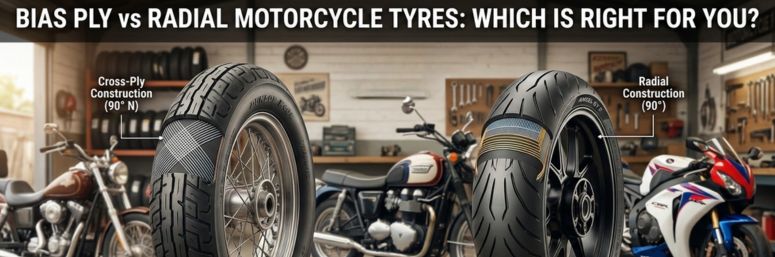
Beyond shape, construction type also matters. Most modern tyres use radial construction, which offers better flexibility, heat dissipation, and grip consistency. In contrast, bias-ply tyres have a stiffer structure, providing durability and load capacity but less adaptability during aggressive cornering.
The interaction between profile curvature and sidewall rigidity tuning determines how responsive the bike feels when transitioning into and out of corners. A well-balanced tyre provides predictable handling and strong rider feedback.
Rubber Compound – Soft vs Hard Tyres
The rubber compound of a tyre significantly affects its grip characteristics. Soft compound tyres provide superior traction because they can deform more easily and adapt to the microscopic texture of the road surface. This behavior is enhanced by rubber elasticity under heat cycles, which allows the tyre to maintain flexibility at optimal temperatures.
However, repeated heating and cooling—known as heat cycles—gradually degrade the compound, reducing its effectiveness over time. Extreme conditions can also lead to cold tearing or hot tearing, both of which negatively impact grip and tyre longevity.
Hard compound tyres, on the other hand, offer greater durability and are better suited for long-distance riding and commuting. While they provide less peak grip, they maintain more consistent performance over extended use.
Tread Pattern and Motorcycle Tyres Affect Cornering Grip
Tread patterns are designed not only for aesthetics but for functionality. In dry conditions, a larger contact area improves grip, which is why racing tyres often use slick designs. However, real-world riding involves water, dust, and debris.
In such conditions, tread grooves play a critical role in channeling water away from the contact patch, preventing hydroplaning and maintaining traction. Advanced tread designs also focus on rolling resistance reduction and improved wet traction efficiency, especially for riders navigating urban environments or highways during rainy conditions.
Tyre Pressure – The Silent Grip Killer
Tyre pressure is one of the most critical yet commonly neglected factors affecting cornering grip. Incorrect pressure alters the shape and effectiveness of the contact patch, directly impacting traction and stability.
Overinflated tyres reduce the contact area and limit deformation, resulting in less grip and a harsher ride. Underinflated tyres, on the other hand, increase flex and heat buildup, leading to instability and uneven wear.
Additionally, improper pressure affects tyre feedback response, making it harder for riders to sense available grip during cornering. Maintaining correct pressure ensures consistent performance and predictable handling.
Tyre Temperature – Why Warm Tyres Grip Better
Temperature plays a vital role in tyre performance. Warm tyres are more flexible and capable of conforming to road irregularities, improving mechanical grip. This increased flexibility is due to enhanced molecular flexibility of rubber compounds at higher temperatures.
However, tyres must operate within an optimal range. Excessive heat can reduce thermal stability, causing the tyre to feel greasy and lose grip, while cold tyres remain stiff and less effective.
Contact Patch – The Real Grip Zone
The contact patch is where all forces are transmitted between the motorcycle and the road. Despite being roughly the size of a credit card, it handles acceleration, braking, and cornering forces simultaneously.
Grip in this area depends on load, pressure, and surface interaction. Engineers now analyze real-time contact patch deformation to better understand how tyres perform under different riding conditions, helping improve overall grip and safety.
Suspension and Tyres – A Perfect Partnership
Tyres and suspension must work together to maintain consistent grip. Suspension systems control unsprung mass dynamics, ensuring that tyres remain in contact with the road even over uneven surfaces.
If the suspension is too stiff, the tyre may lose contact over bumps. If it is too soft, excessive movement can reduce stability. A properly tuned suspension allows for smooth load transfer and optimal tyre performance during cornering.
Road Conditions and Tyre Interaction
Tyre performance varies significantly depending on road conditions. Fresh asphalt with strong texture provides excellent grip, while polished or wet surfaces reduce friction. Gravel and debris further limit traction.
Different riding environments—such as urban roads, highways, and track environments—place unique demands on tyres. Riders must adapt their riding style and tyre choice accordingly, especially in changing weather conditions.
Wear Patterns and Reduced Cornering Grip
Tyres degrade over time due to both physical wear and chemical changes. While visible issues like uneven wear patterns can affect handling, less obvious factors such as compound oxidation reduce elasticity and grip.
Repeated use and environmental exposure gradually harden the rubber, lowering its ability to conform to the road surface. This reduction in flexibility directly impacts cornering performance.
Tyre Width and Grip – Wider Means Better?
While wider tyres may increase potential contact area, they do not automatically improve grip. Effective traction depends on proper load distribution, compound characteristics, and tyre design.
Incorrect sizing can negatively affect motorcycle geometry compatibility, altering steering response and reducing agility. Choosing the correct tyre width is about balance rather than simply going wider.
Choosing the Right Tyres for Better Cornering
Selecting the right tyres involves more than just performance preferences. Riders must consider their motorcycle type, riding style, and environment. Compatibility with sport, cruiser, and commuter motorcycles is essential, as each category has different performance requirements.
Environmental factors such as hot weather, monsoon conditions, and cold temperatures also influence tyre choice. Leading manufacturers like Michelin, Pirelli, and Bridgestone design tyres with specific compounds and structures to perform under varying conditions.
Common Mistakes Riders Make
Many riders unknowingly reduce their cornering grip through avoidable mistakes. These include ignoring tyre pressure, mixing incompatible tyre types, and neglecting suspension setup. Additionally, overlooking tyre compatibility specifications and the role of electronic rider aids interaction can lead to unpredictable handling.
How to Improve Cornering Grip Instantly
Improving cornering grip doesn’t always require major changes. Simple actions such as maintaining proper tyre pressure, inspecting wear regularly, and warming up tyres before aggressive riding can make a significant difference.
Ensuring proper tyre installation, balancing, and wheel alignment further enhances stability and grip. Combined with smooth throttle and braking inputs, these adjustments can dramatically improve both safety and riding confidence.
For more details, Click Here